The first thing Elias Vale heard was the knocking under the floorboards.
Three slow knocks. Then silence.
Three more.
It was the kind of sound that makes a person stop breathing. The kind that turns an ordinary night into a story people whisper about years later. One usually told after checking that all the windows and doors are locked.
Elias had lived beside the Oregon Coast for nearly six years by then. He had crossed the Oregon Trail in a wagon train. He survived bitter mountain snow and muddy river crossings.
He even had a memorable argument with a mule named President Polk. He had settled near a lonely stretch of beach south of what would eventually become a proper coastal town.
His cabin stood where the forest thinned into dunes. Beyond the grass, the Pacific rolled and muttered in the darkness.
Elias liked the ocean.
He respected it, too.
But he never trusted it.
Not after the night of the knocking.
This is a fictional ghost story inspired by the Oregon Coast’s pioneer history, shipwreck folklore, sea-monster tales, and long tradition of strange happenings in the fog.
The Man Who Came West
Elias Vale was not the sort of man people expected to become a ghost.
He was broad-shouldered, practical, and fond of hot coffee. He had a reddish beard and a permanent squint from too many years staring into bright skies.
He also had a habit of talking to himself whenever a chore went badly.
Which was often.
He had crossed the plains with his wife, Clara, and their two children in 1847.
The journey west had taken months. By the time they reached Oregon, their wagon was missing a wheel, two chickens, and most of Clara’s patience.
The family first settled inland. But Elias wanted timber, fresh air, and a piece of land where he could hear himself think.
So he followed the rivers toward the coast.
He built his cabin near a narrow creek that emptied into the ocean. There was a spring nearby, a patch of ground suitable for potatoes, and enough driftwood along the beach to keep the stove burning through winter.
The ocean was less cooperative. It sent rain sideways.
It chewed away at the cliffs.
And some nights, when the fog rolled in thick enough to swallow the moon, it made sounds that seemed almost human. Clara hated those nights.
“Water doesn’t call a man’s name,” she told Elias once.
Elias glanced toward the black window.
“No,” he said. “But the wind might.”
The wind, however, had never left wet marks on the floor.
Three Knocks Beneath the Cabin
The knocking began in late October.
A storm had blown in from the west, shaking the cabin walls and flinging sand against the windows. Elias had spent the evening repairing a broken shutter while Clara kept the fire alive.
Their children were asleep in the loft.
The tide was high.
Then came the first knock.
Thump.
Elias froze.
A second knock followed.
Thump.
Then a third.
Thump.
Clara looked up from her sewing.
“What was that?”
Elias grabbed the lantern and lifted the trapdoor in the corner of the room. Beneath it was a shallow storage space dug into the earth. He kept potatoes there, along with tools and a few jars of preserved berries.
Nothing moved.
The dirt floor was dry.
The potatoes sat undisturbed.
Elias lowered the lantern.
Then something brushed the underside of the floorboards.
Not scratched.
Brushed.
As if a hand, or something with many fingers, were feeling its way across the wood.
Clara pulled the children from the loft and gathered them close. Elias stood over them with an axe until dawn.
In the gray morning, they found a trail of seawater leading from the cabin door to the trapdoor.
There were no footprints.
Only eight long grooves pressed into the mud.
The Shape Beneath the Waves
After that, Elias stopped walking the beach alone. For a while.
The trouble was, the beach kept offering him things. Like a silver button and a child’s wooden cup.
Then, one morning, he found a dead seal lying above the high-tide line. Its body was untouched, but the sand around it was covered in enormous round impressions.
Clara saw them and went pale.
“Those aren’t from a bear.”
“I know.”
“Then what made them?”
Elias looked toward the ocean.
The water was calm that morning. Too calm. A flat sheet of pewter beneath a sky the color of old bones.
“Something hungry,” he said.
That evening, the family heard singing from the beach.
It was faint at first. A thin, wavering sound rising and falling with the surf.
Clara thought it was a gull.
Elias knew better.
The song had words.
His name was one of them.
A Legend with Too Many Arms
The local people had their own stories about the waters and lakes of the coast. Stories of beings beneath the surface.
Stories of creatures that could overturn a canoe, pull a person into the dark, or wait patiently for someone foolish enough to wander too close.
Elias had heard these tales. He listened respectfully, pretending not to be frightened.
Then he heard a different version from an old fisherman who stopped by the cabin one afternoon.
The fisherman called the creature the Deep Hand.
He said it lived in a cave beneath the headland, where sunlight never reached. It was big. The size of a wagon house. Arms long enough to curl around a tree.
And its skin changed color with the water. Its eyes were pale and bright.
“Why would it come near the shore?” Elias asked.
The fisherman stared at him.
“Maybe it doesn’t,” he said. “Maybe the shore comes near it.”
That night, Elias nailed a horseshoe above the door.
Clara took it down.
“If iron worked against monsters,” she said, “the whole coast would be covered in horseshoes.”
She had a point.
The Night Elias Disappeared
The final night arrived in November.
Moonlight tried in earnest to reach the ground but failed to penetrate the deep, thick fog.
Elias woke just after midnight.
The knocking had returned.
This time, it came from inside the cabin.
Thump.
From beneath the floor.
Thump.
From beneath his bed.
Thump.
Elias sat up. At the window, something pale moved through the fog. He reached for the lantern.
Clara caught his wrist.
“Don’t.”
“I need to see what it is.”
“No,” she whispered. “You need to stay here.”
The knocking stopped. Then came a sound from outside. A wet dragging noise. Slow. Heavy.
Getting closer.
Elias grabbed the axe. Clara pleaded with him, but he was already pulling on his coat. Before he opened the door, he looked back at her.
“If I’m not back by sunrise…”
“You’ll be back.”
“Clara.”
“You’ll be back,” she repeated, though her voice shook.
Elias stepped into the fog. The door swung shut behind him.
Clara heard his boots cross the porch. She heard him call once. Then the ocean answered with a roar.
The cabin shook. The children woke screaming. Something struck the beach with enough force to rattle the dishes from their shelves.
Clara ran to the window.
For one second, she saw Elias standing at the edge of the water.
He was holding the lantern.
Behind him, the fog bulged upward.
A huge shape rose beneath it.
There were arms.
So many arms.
They curled around Elias without a sound. The lantern dropped into the surf. Its flame flickered once, glowing amber beneath the black water.
Then Elias vanished.
The fog closed and the ocean went still.

The Search
Neighbors searched for Elias until the storm broke three days later. They found his coat caught on a piece of driftwood.
They found the axe half-buried in the sand. They found a single boot near the creek. They did not find Elias.
No body washed ashore. No trail led into the forest. No boat had passed nearby. The sea had taken him, and the sea refused to explain itself.
Clara and the children eventually moved inland.
Before she left, Clara walked through the empty cabin one final time.
The floorboards were damp and the trapdoor stood open.
On the dirt below, someone, or something, had arranged eight smooth black stones in a circle.
At the center lay Elias’s wedding ring.
The Ghost on the Beach
Years passed.
The settlement grew. More cabins appeared. Roads were cut through the forest. Travelers came to see the cliffs, the dunes, and the restless Pacific.
But people still spoke of Elias Vale.
A woman walking the beach after sunset claimed she saw a lantern moving through the fog.
A boy collecting driftwood heard three knocks beneath the sand.
A fisherman swore he saw a bearded man standing waist-deep in the surf, staring toward shore.
And once, during a winter storm, a family staying near the old cabin heard someone walking around their house.
Slow footsteps. Wet boots.
A pause beside every window.
Then three knocks beneath the floor.
Thump.
Thump.
Thump.

What Really Took Elias?
There are sensible explanations, of course.
The Oregon Coast is dangerous. Rip currents, sneaker waves, unstable cliffs, and sudden storms have taken many people over the years.
A person can disappear quickly in the surf, especially at night.
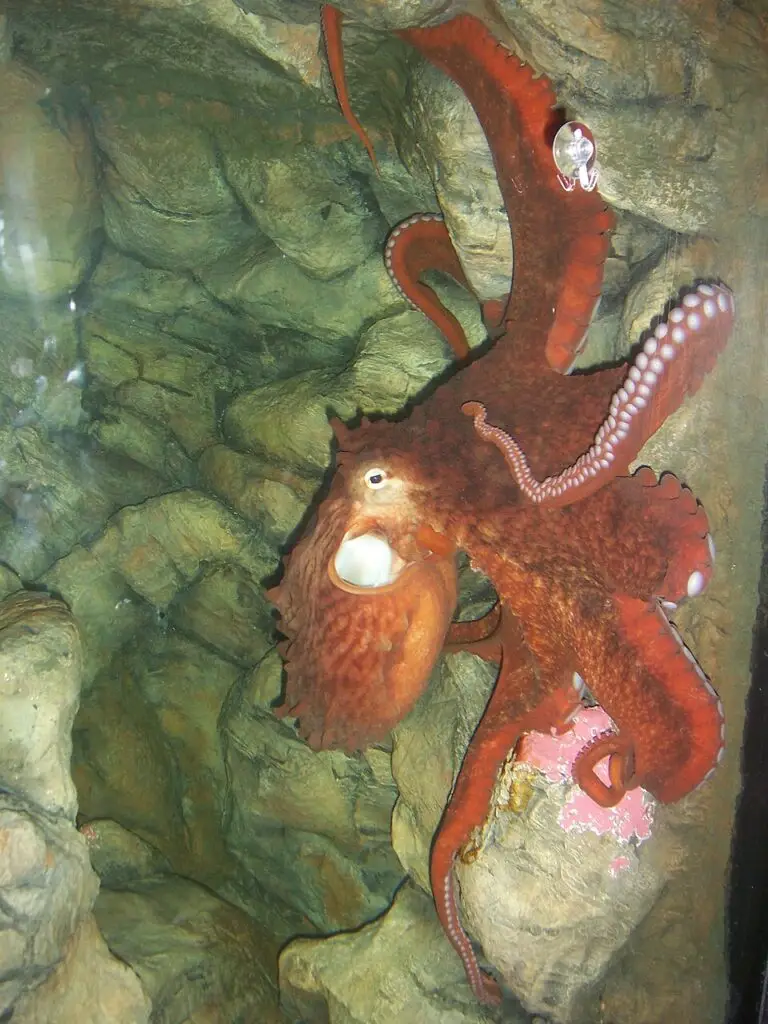
And giant Pacific octopuses are real.
They live in the cold waters along the Pacific Northwest, including Oregon. They are powerful, intelligent, and much larger than most people expect.
You can learn more about them through the Oregon Coast Aquarium’s giant Pacific octopus guide.
But a normal octopus could not drag a grown pioneer from a beach, probably?
The thing about coastal legends is that they grow in the dark. One person sees a shadow. Another hears a noise. A third adds a detail, perhaps because the story needs one.
After a few winters, a strange wave becomes a tentacle and a missing man becomes a ghost.
The Oregon Coast is full of tales like this: phantom lights, restless sailors, haunted lighthouses, and figures moving where no living person should be.
You can find more of them in Ghosts of the Oregon Coast: 7 Real Haunted Locations You Can Visit, along with stories tied to Heceta Head, Fort Stevens, Yaquina Bay, and other places where history seems to linger in the mist.

If You Hear the Knocking
Maybe Elias Vale was swept away by a rogue wave or slipped from a cliff.
Maybe the fog hid something with pale eyes and arms longer than tree trunks.
No one knows.
But if you visit the Oregon Coast on a cold night and hear three knocks beneath your feet, don’t investigate. Don’t call out. And whatever you do, don’t carry a lantern down to the water.
Because sometimes, far beyond the breakers, a pale shape rises beneath the waves.
And sometimes, through the thick fog, you may see a man in an old coat, walking beside it.