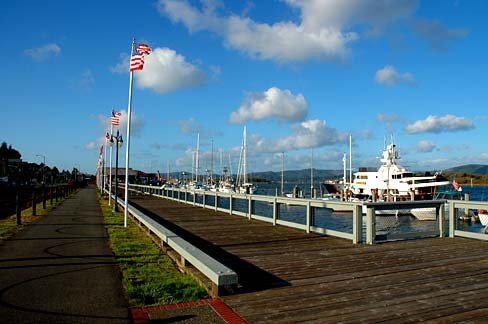
Ever spent a morning at the Charleston docks? You’ll know the sound.
It’s a low, rhythmic groan of weathered hulls against wood and the cry of gulls cutting through the salt air. A steady, quiet hum of a community that lives and breathes by the tide.
But if you sit long enough at one of the local restaurants, you might hear something else.
You might hear about the things that don’t show up on a sonar screen.
The Oregon Coast is full of ghost stories. We’ve covered the haunted lighthouses and the restless spirits of old boardwalks, but in Coos Bay, the most chilling legend isn’t on land.
It’s found at the “Graveyard of the Pacific,” specifically at the Coos Bay Bar. This is a place where the deep Pacific meets the river mouth in a violent, unpredictable clash of water.
Let me tell you the story of the White Chinook.
The Bar and the Fog
To understand the story, you have to understand the Coos Bay Bar. It is, by all technical accounts, a nightmare for mariners. When a strong ebb tide hits a heavy ocean swell, the water stacks up into steep, breaking walls that can roll a commercial boat like a toy.
It’s a place of “regulated navigation,” where the Coast Guard keeps a constant, watchful eye on the “No-Go” zones like Guano Rock and the submerged jetty tips.
It was on a night like this, thick with “pea-soup” fog and a mounting swell, that a fisherman named Silas found himself alone on the water.
Silas was no novice. He had fished these waters for decades, his hands calloused by miles of line and years of salt spray.
He knew the Bar’s moods, and when to stay in, and when to push through.
But that night, the fog had moved in with a predatory speed. It swallowed the lights of the Charleston jetties before he could make his turn back to the docks.

The Encounter off Guano Rock
In the air was a kind of dead, heavy silence. Silas was idling his troller, waiting for a break in the mist.
Then his reel suddenly screamed.
Whatever was on the other end didn’t fight like a typical Chinook. There was no head-shake, no frantic run. Just a heavy, steady weight that felt like he’d hooked the bottom of the ocean: except the bottom was moving.
As he began to winch the line in, the water alongside the boat began to glow. It wasn’t the usual bioluminescence of disturbed plankton.
This was a pale, sickly cyan light that seemed to pulse from deep within the black water.
Then, it broke the surface.
It was a salmon, but a monster of one: massive, easily five feet long, with scales that weren’t silver, but a translucent, milky white.
It looked like a piece of carved marble that had been left to rot at the bottom of the sea. But it was neither the size nor the color that made Silas’s blood turn to ice.
It was the eye.
As the fish rolled near the hull, it turned its head.
Instead of the flat, vacant stare of a fish, Silas looked into an eye that was undeniably human.
It was wide, intelligent, and filled with a profound, ancient sorrow: one that didn’t look at Silas as prey or as a captor, but like a witness.
The Choice to Cut the Line
In that moment, the temperature on the deck dropped. The cloying scent of old wood and wet earth replaced the smell of the salt air.
A wave of pure, unadulterated dread washed over Silas: a feeling that he was intruding on something that wasn’t meant for the living.
Without a second thought, Silas didn’t reach for the net. He reached for his deck knife.
With one swift motion, he sliced through the heavy test line. The tension snapped, and the White Chinook didn’t dive; it simply faded. One moment it was there, a glowing ghost in the dark water, and the next, it was gone, leaving only the sound of the waves slapping against the hull.
The fog lifted almost immediately. The range lights of the Coos Bay entrance appeared like two welcoming stars, and Silas throttled up, not stopping until he tied up tightly at the Charleston docks.

The Guardian of the Lost
When Silas told his story the next morning to the old-timers over breakfast, he expected to be laughed out of the room. Instead, the table went silent.
The “White Chinook” isn’t a new story in Coos Bay.
Among the families who have fished these waters for generations, the spectral salmon is known as a “Spirit Fish.” It doesn’t appear for everyone, and it doesn’t appear without reason.
Some say the White Chinook is a guardian: the collective spirit of the mariners lost to the Bar, returning to guide the living away from the edge.
Others say it is an omen of maritime tragedy. They point to the wrecks that have happened in the days following a sighting, claiming the fish appears to warn of a coming “rogue” season.
“You did the right thing cutting that line, Silas,” one retired skipper supposedly told him. “You don’t catch the White Chinook. If you bring that fish over the rail, you’re inviting the whole ocean into your boat. Some things are meant to stay under the waves.”
Visiting Charleston Today
Today, the Charleston docks remain a hub of Oregon’s fishing industry. You can visit the local shops to see the gear that keeps the fleet running or walk the docks to see the modern trollers that brave the Bar every day.

But next time you’re standing on the South Jetty, watching the mist roll in over the breakers, keep an eye on the water.
If you see a pale glow beneath the surface, or if you feel a sudden, inexplicable chill in the salt air, don’t cast your line.
The White Chinook is still out there, patrolling the boundary between the river and the sea, watching over the Bar with those all-too-human eyes.