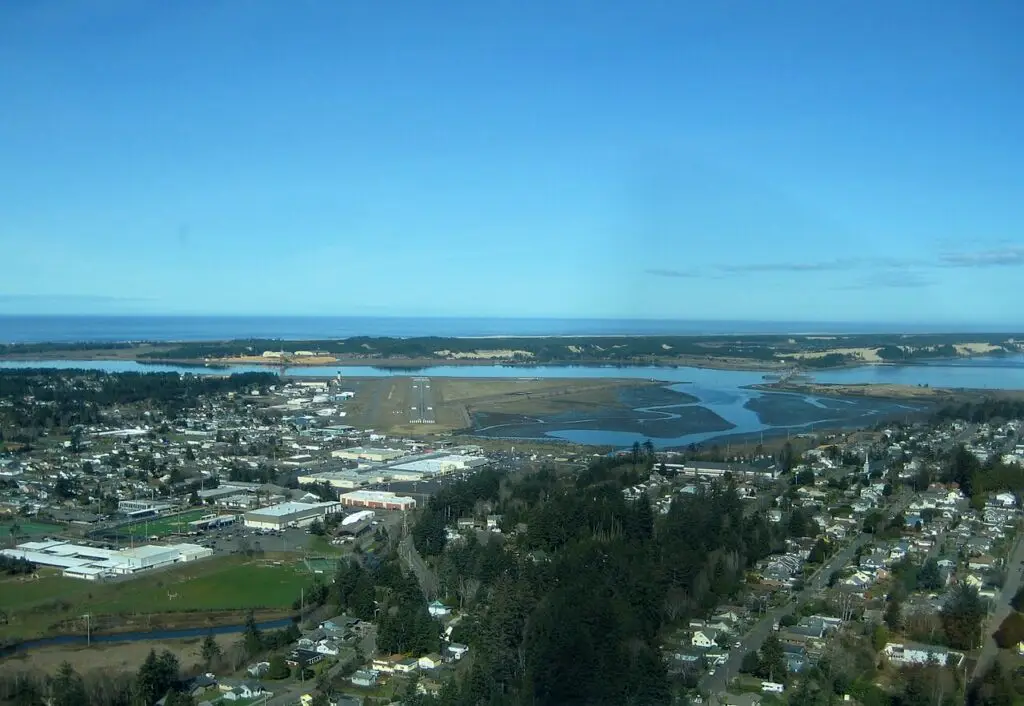
North Bend curves around the upper reaches of Coos Bay, where water, timber and industry have shaped the city for more than a century.
The name sounds geographic—and it is—but the city did not simply appear at the north bend of the bay. It was deliberately assembled from family timber holdings, an older townsite called Yarrow and Louis J. Simpson’s enormous ambitions.
Coos Homeland First
The Coos Bay estuary was homeland to Coos people long before ships, mills or city plats. The bay and its sloughs provided salmon, shellfish, waterfowl, plants and protected canoe routes between villages.
That Indigenous history continues through the Confederated Tribes of Coos, Lower Umpqua and Siuslaw Indians and the Coquille Indian Tribe, whose communities remain part of the region today.
Before North Bend, There Was Yarrow
During the late 1800s, lumberman Asa Meade Simpson developed mills, docks and shipping operations on the north side of Coos Bay. Nearby was an undeveloped townsite called Yarrow.
Asa’s son, Louis Jerome Simpson—usually called L.J.—arrived in 1899 to help manage the family business. He purchased Yarrow and combined it with his father’s property.
L.J. Simpson Built a City
In 1903, Simpson brought the combined townsite together as the City of North Bend. He wanted more than a company settlement. His model was San Francisco: a busy waterfront city with industry, civic institutions and room to grow.
To attract development, he donated waterfront land for factories and gave other property for churches and a hospital. He recruited professionals, encouraged new businesses and served as North Bend’s first mayor until 1915.
The Waterfront Became the Front Door
Roads through the Coast Range were difficult, so early North Bend depended on water. Ocean-going ships crossed the Coos Bay bar, while smaller boats carried passengers and cargo around the bay and into its sloughs.
Docks, sawmills and lumber yards lined the shoreline. Timber from the surrounding forests moved through North Bend on its way to markets far beyond Oregon.
Fun Fact: The Founder Built Shore Acres
Between 1906 and 1907, L.J. Simpson built a grand oceanfront estate south of town for his wife Cassandra. The mansion later burned, but the formal gardens and dramatic headland became Shore Acres State Park.
That means one of the Oregon Coast’s best-known parks is directly tied to the same family that assembled North Bend.
The Bay Still Defines North Bend
The old mills and shipping operations have changed, but North Bend still faces the water. The working bay, the McCullough Memorial Bridge, nearby tribal enterprises and the city’s industrial shoreline all reflect layers of the same history.
The next time you cross into North Bend, remember Yarrow beneath the modern street grid—and L.J. Simpson’s decision to turn a timber town into a city.
Featured photo: “North Bend aerial” by Brian Burger (WireLizard), via Wikimedia Commons, licensed under CC BY 2.0.