Powers sits deep in the Coast Range at the upper end of the South Fork Coquille River. It feels far removed from the ocean towns, but its history is tied directly to the mills and shipping docks of Coos Bay.
The city was created by timber—and named for one of the men who organized the industry around it.
Coquille Homeland First
The South Fork Coquille watershed was part of the homeland of Coquille people long before logging camps or railroad grades entered the valley. The river and surrounding forests supported fishing, hunting, gathering and travel between communities.
That history remains connected to the modern Coquille Indian Tribe and to a watershed whose name survived every later layer of development.
Timber Companies Looked Inland
By the early 1900s, lumber companies working around Coos Bay were searching farther inland for large stands of Douglas-fir. Charles Axel Smith and his Oregon partner, Albert H. Powers, built a network of logging operations to supply Smith’s enormous mill on the bay.
The Smith-Powers Logging Company operated camps along the forested tributaries of Coos County. Rail lines carried logs out of valleys that had previously been difficult to reach.
A Town Named for Albert Powers
A permanent community grew around the company’s operations on the South Fork. In 1914, it was named Powers for Albert H. Powers, vice president and general manager of the Smith-Powers Logging Company.
The Powers post office opened in 1915. Company buildings, bunkhouses, workshops, stores and family homes turned the remote camp into a recognizable town.
The Railroad Was the Lifeline
Logging railroads did more than move timber. They carried equipment, food, mail and people through the narrow river valley. Steam locomotives and logging spurs connected Powers to mills and markets around Coos Bay.
Work was dangerous and physically demanding. Fallers cut enormous trees, choker setters fastened cables around logs, and crews moved timber across steep, wet ground using steam donkeys and rail equipment.
A Company Town Became Its Own City
Smith-Powers eventually became part of larger lumber operations, but the community remained after the original company era changed. Powers incorporated as a city in 1945.
Timber continued to dominate local life for decades. When the industry contracted, Powers had to redefine itself as a small independent community rather than an outpost of a single company.
Fun Fact: The Camera Preserved the Logging Town
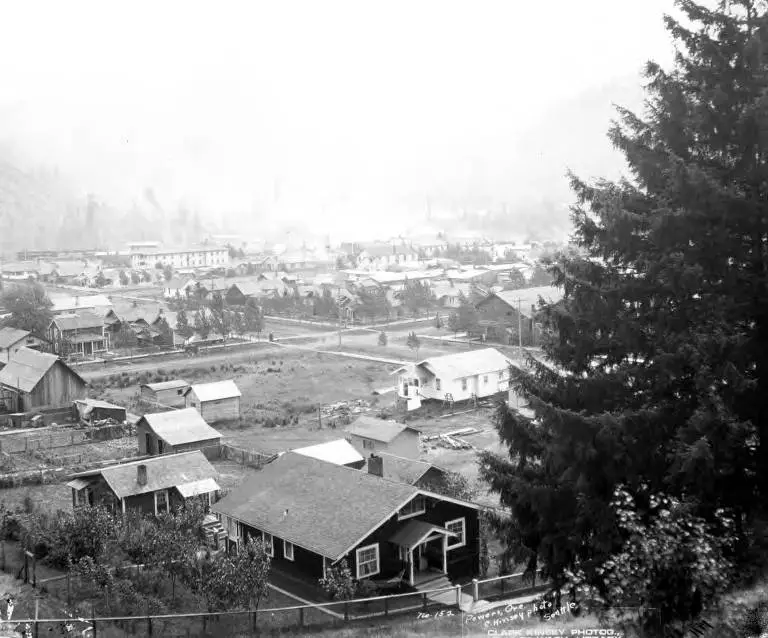
Photographer Clark Kinsey documented Smith-Powers camps and the town during the 1920s. His images show log ponds, steam equipment, camp crews and Powers itself surrounded by freshly worked hillsides.
Those photographs preserve details of everyday company-town life that written records often miss.
The Valley Still Explains Powers
Powers remains surrounded by the river, mountains and forests that created it. The rails are gone, but old grades, equipment, photographs and family stories keep the logging era close.
The name on the map belongs to Albert Powers. The town that survived belongs to generations of people who stayed after the company moved on.
Featured photo: “View of the town of Powers, Smith Powers Logging Company, Powers, ca. 1922” by Clark Kinsey, via Wikimedia Commons. Public domain.

.jpeg)