Reedsport stands where rivers, rails, dunes and Highway 101 meet. The town looks inland and toward the Pacific at the same time, with the lower Umpqua carrying both stories through it.
Its name belongs to Alfred Reed. The town itself was shaped by Indigenous homeland, salmon canneries, railroad construction, timber and a flood that changed downtown.
Lower Umpqua and Siuslaw Homeland First
Long before settlement, Siuslaw-speaking Lower Umpqua and Siuslaw people lived along the coastal rivers. They fished salmon runs, built cedar-plank houses and traveled through a landscape organized around water.
In 1861, the U.S. Army forcibly removed many Lower Umpqua and Siuslaw people to the Alsea Subagency. Many later returned. Their descendants are represented today by the Confederated Tribes of Coos, Lower Umpqua and Siuslaw Indians.
Gardiner Came Before Reedsport
Euro-American settlement near the Umpqua began in the early 1850s. Gardiner developed closer to the river’s mouth, while Scottsburg grew farther upstream.
The future Reedsport townsite remained a marshy tidal flat between the Umpqua River and Rainbow Slough. Its location was useful, but building on it required docks, pilings and eventually large amounts of fill.
Warren Reed Named the Town for His Uncle
Local landowner and businessman Warren Reed promoted a town near the Elmore Packing Company’s fish cannery, built in 1910. He named it Reedsport for his uncle Alfred W. Reed, a prominent early settler of Gardiner.
The post office opened in 1912, and Reedsport incorporated in 1919.
Salmon, Stilts and Railroad Tracks
Early waterfront buildings stood on pilings above the tidal flat. Commercial crews caught salmon in the Umpqua, and workers processed the fish for shipment to distant markets.
The Southern Pacific Railroad arrived in 1912 and transformed the lower Umpqua. Logging expanded rapidly, mills opened and enormous rafts of logs crowded the river. By 1927, much of the tidal waterfront had been filled to create the ground beneath modern downtown.
Floodwater Changed the City Again
The Christmas Flood of 1964 inundated downtown Reedsport and damaged nearly every building. In 1968, the Army Corps of Engineers completed a levee system around the vulnerable part of town.
Like the earlier waterfront fill, the levee changed the relationship between the city and the river without removing the river’s importance.
Fun Fact: The Dunes Became a New Economy
Congress created the Oregon Dunes National Recreation Area in 1972 and placed its headquarters in Reedsport. Recreation gradually replaced timber as a major economic force.
Today, visitors come for the dunes, fishing, crabbing, camping and the region’s famous chainsaw-carving events.
The River Still Holds the Story Together
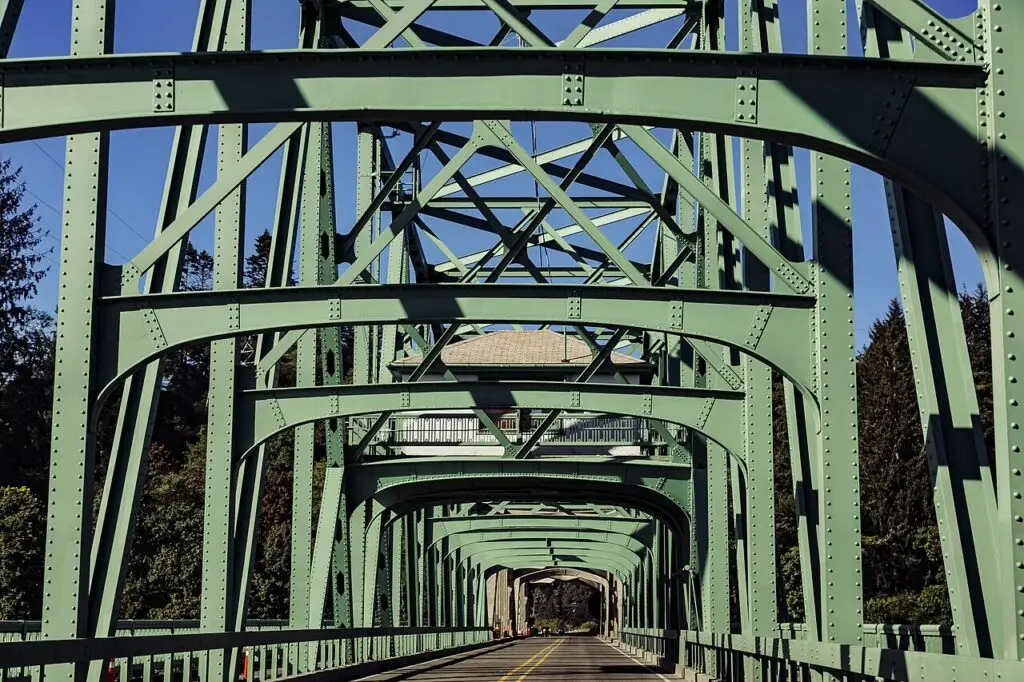
The Umpqua River Bridge, railroad bridge and working waterfront reveal the different eras at a glance. Reedsport is not simply a highway stop near the dunes. It is a town built on marshland, carried by salmon and timber, and repeatedly reshaped by water.
Featured photo: “Umpqua River Swing Bridge, Reedsport, Oregon” by Tony Webster, via Wikimedia Commons, licensed under CC BY-SA 2.0.

.jpg)