Waldport sits where the Alsea River widens into a broad tidal bay. Forest rises behind town, the Pacific lies just beyond the bridge, and nearly every chapter of local history follows the water.
The city’s name combines forest and port. The place itself was Alsi homeland long before either word appeared on a town plat.
Alsi Homeland First
Alsi, or Alsea, people lived around the lower estuary in large plank houses during winter. Throughout the year, families traveled between seasonal camps to fish, hunt and gather shellfish and plants.
The river takes its name from those Indigenous villages. In 1859, the federal government established the Alsea Subagency of the Coast Reservation on the bay. Congress disbanded it in 1875.
Settlement Arrived by Water
Early Euro-American settlers relied on canoes and homemade boats to bring food, tools and building supplies down the Alsea River. Roads were poor, and crossing the bay required a boat.
Settlement at the future townsite increased after 1879. The plat for Waldport was recorded in 1885.
The Name Means Forest Port
Many early settlers were of German descent. The proposed name Waldport joined the German word wald, meaning forest, with “port” for the community’s location near the ocean and bay.
The town incorporated in 1911. By then, it had about a dozen businesses and roughly 150 residents.
Salmon Built the Waterfront
Native villages and commercial salmon canneries shared the bay during the late nineteenth century. Fishing crews set and repaired nets by hand, while boats carried catches to waterfront processors.
The Port of Alsea district formed in 1910. Commercial salmon fishing remained important for decades before closing in 1957, leaving the fishery primarily to recreational anglers.
The Bridge Changed Daily Life
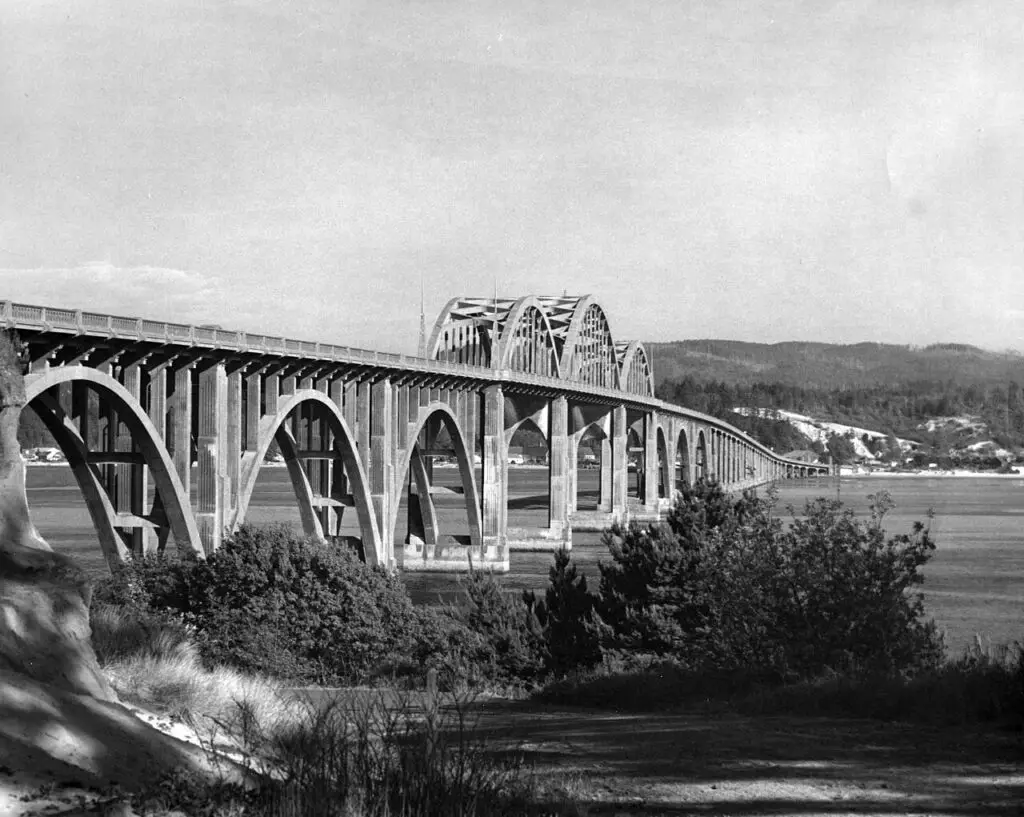
Before 1936, Highway 101 traffic crossed Alsea Bay by ferry. Engineer Conde B. McCullough designed a graceful concrete-arch bridge that opened that year as part of the Oregon Coast Highway bridge-building program.
Saltwater corrosion eventually weakened the original structure. It was replaced in 1991 by the bridge that carries Highway 101 today.
Fun Fact: A Wartime Arts Community Formed Nearby
During World War II, Civilian Public Service Camp No. 56 operated south of Waldport for conscientious objectors assigned to unpaid work of “national importance.”
Writers and artists at the camp founded the Untide Press, creating poetry and artwork that challenged conformity during the war years.
The Bay Still Explains Waldport
The modern bridge, port docks, fishing boats and old town waterfront all follow the same estuary that supported Alsi communities and later settlers.
Waldport’s name may mean forest port, but the Alsea River is the thread holding every era together.
Featured photo: “Alsea Bay Bridge at Waldport, Oregon” by Wanda Gifford, via Wikimedia Commons. No known copyright restrictions.

.jpg)