Toledo sits inland from Newport on a bend of the Yaquina River. It is close enough to feel the tides, yet protected enough to become the industrial heart of Lincoln County.
The river, railroad and surrounding forests made the town. They also placed Toledo inside national stories of wartime production, labor and racial exclusion.
Yaquina and Alsea Homeland First
The Yaquina River region was home to Native communities connected to the Yaquina and neighboring Alsea peoples. The river and bay supported salmon, shellfish, plants, travel and trade long before mills occupied the shoreline.
During the nineteenth century, federal removal and reservation policies displaced Native people and opened the area to Euro-American settlement.
A Town Established in 1866
John Graham, William Mackey and Joseph Graham established Toledo in 1866 under the Homestead Act. The location offered access to the Yaquina River and to extensive timber stands inland.
By 1890, downtown included a waterfront hotel, saloon, feed stable, blacksmith shop, school, churches and sawmills.
The Railroad Connected River and Valley
The Corvallis and Yaquina Bay Railroad Company was incorporated in 1872. The final spike in the rail line was driven on July 4, 1885.
The tracks did not end in Toledo, but they changed the town. People, machinery and lumber could move between the coast and the Willamette Valley much faster than before.
Even Toledo’s Incorporation Date Is Complicated
Records show that Toledo wrote its first ordinance and elected officials in 1893. A businessman later challenged that incorporation because the city boundaries had not been described correctly.
Residents continued electing leaders and conducting city business. Toledo’s official city seal carries the date 1905, leaving the community with two important municipal dates instead of one tidy answer.
Spruce Made Toledo a Wartime Mill Town
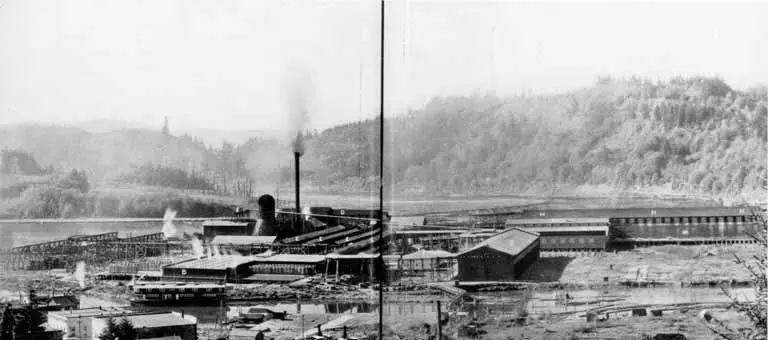
During World War I, lightweight spruce was urgently needed for military aircraft. The federal government developed a large spruce mill in Toledo and built railroad infrastructure to bring timber out of the surrounding forests.
The war ended before the mill reached full production. Private operators later acquired the facilities, and the C. D. Johnson Lumber Company employed about 800 people by 1924.
A Hard Chapter: The 1925 Japanese Exclusion
In 1925, the mill hired Japanese workers for difficult jobs at lower wages than white workers. A public demonstration became a violent mob action, and the Japanese workers were forced from their homes and driven out of Toledo.
Five workers later won a lawsuit against leaders of the mob. The episode remains an important part of Toledo’s history and a reminder that economic growth did not benefit everyone equally.
Fun Fact: The Mill Outlasted Every Owner
Georgia-Pacific purchased the C. D. Johnson Lumber Company in 1952. The mill continued to anchor Toledo’s economy through changing companies, technology and timber markets.
The next time you see the mill beside the Yaquina River, remember the layers beneath it: Native homeland, homesteads, riverboats, railroad tracks, wartime spruce and generations of mill workers.
Featured photo: “Pacific Spruce Lumber Company on the Yaquina River, Toledo, Oregon” by an unknown photographer, via Wikimedia Commons. Public domain.


.jpg)